Paai vs. a Partnerships Consultancy: You Keep the Machine
If partnerships is a priority and you do not have a partner team, you have three options. Hire someone and wait two quarters to find out if the motion works. Buy software and hope someone has time to use it. Or hire a consultancy.
We get compared to the third one often, so here is the difference stated plainly.
A partnerships consultancy sells you hours. Senior people, real expertise, a scoped engagement, a deliverable at the end. Then the engagement closes and they walk out the door with everything they learned about your ecosystem in their heads. You keep a deck.
Paai sells you an outcome, and leaves the machine behind.
What you never do with Paai
partner success signals
Start with what is absent, because in this category the absences are the product.
No discovery calls.
You do not book a call to find out whether we can help. You upload your target accounts or describe your goal and the platform answers. Today.
No 90-day campaigns.
Nobody scopes a phase one. There is no research phase that produces a findings document in month three.
No partner snake oil.
No "ecosystem strategy" that arrives as a framework diagram. No promise that your program will transform, with the specifics arriving later.
What replaces them:
- Data built on more than 5 million partner success signals
- Chat that understands partnerships, not a keyword filter over a firmographics database
- Results in minutes
And what actually comes back:
- Ranked partners matched to your goal
- Every detail you need to decide whether a partner is worth your time
- Key stakeholders already showing signals they would take your call
- Custom messages built to land the meeting
Free. Immediate. Validated.
That last word matters more than the first two.
A consultancy's list is credible because of who assembled it.
Paai's list is credible because every signal behind every score traces back to a source you can open and read yourself.
What that looks like in practice: ClarifyAI
ClarifyAI is an AI native CRM that grew fast with startups and needed to reach enterprise accounts. Enterprise buyers do not buy a CRM from a website. They buy it through the firms already running their revenue systems. So the goal was enterprise reach through consulting and implementation partners.
They had already done the reasonable thing: launched a partner page, wired agentic workflows behind it, tracked every inbound application. The applications came in and every one of them wanted the same thing, which was to be handed pipeline in exchange for a referral fee. Not the motion the company needed.
The reasonable objection came next. Could you not just run that search in an AI tool and come back with a list?
You can get a list in sixty seconds. Filter a firmographics database for CRM implementation firms serving SaaS, cap the headcount, and you have a few hundred names. The list looks credible, and that is the problem. Every name on it is a category match, not a partnership match, and the best-known firms on it are structurally committed elsewhere: certifications, named practices, delivery teams trained on one stack, revenue tied to a vendor program. Asking them to lead with a new CRM is asking them to unwind years of investment.
Working from the goal rather than the category surfaced two partner types no category list returns:
- Firms building a practice, not defending one. Boutique and mid-size firms with real enterprise delivery capability, no locked-in CRM allegiance, hiring into the practice and looking for a technology to differentiate on.
- Firms adjacent to CRM, with the accounts and none of the baggage. AI, data engineering and cloud transformation firms already inside enterprise accounts. Not CRM shops, which is exactly why they were open.
The results: live partner conversations inside two weeks. With Zirous, twenty-four hours from outreach to a scheduled call. No new headcount, and no consulting engagement to scope.
Paai cut through thousands of wrong partners, and in two weeks we were talking to the ones ready to sell an AI native CRM.
Note what the engagement proved, not just what it produced. Most companies hire a partner leader and then spend two quarters learning whether the motion works. ClarifyAI ran the experiment first, in weeks, before committing to a team. That is the sequencing a consultancy cannot offer you, because a consultancy engagement is itself the expensive commitment.
Read the full story: How ClarifyAI used Paai to gain interest from leading consulting partners in just a few weeks.
Domain Experts are not consultants
Some teams want the workflows run for them rather than by them. That is what a Domain Expert is, and it is the offering people most often mistake for consulting.
Three parts of a Domain Expert engagement do look like people:
- Domain experts who run the partner motions for you.
- A workflow architect who customizes the workflows to your business model.
- Customer success to make sure the goals are actually met.
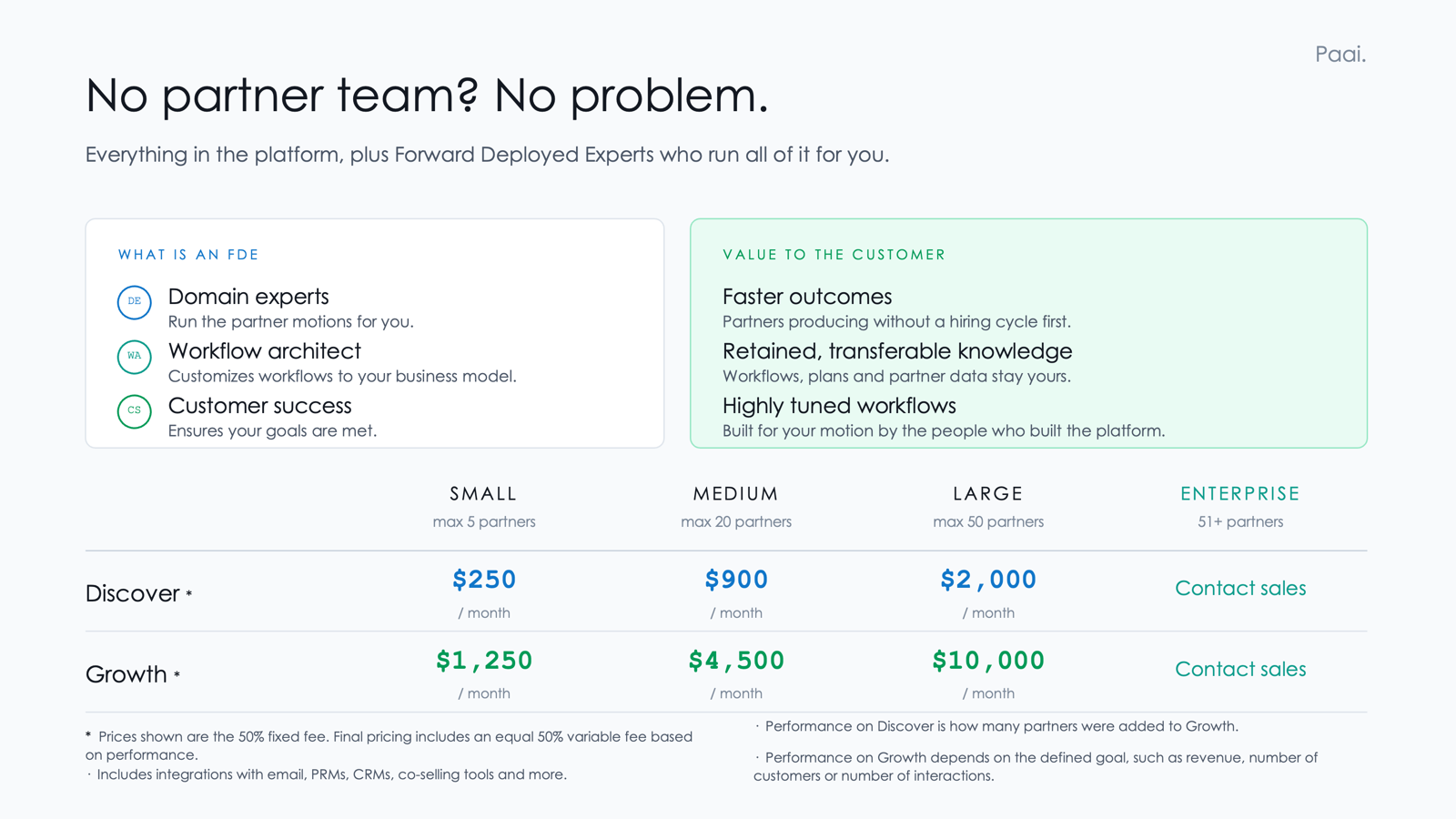 Domain Experts sit on top of the full platform. Prices shown are the fixed half of the fee. The other half is variable, tied to performance.
But Domain Experts come with two things a consultancy structurally cannot include, and they are the reason the comparison breaks down.
the platform, and you keep it.
Everything the Domain Experts build is built inside the product you have access to. The workflows, the partner plans, the research, the scored candidate lists, the stakeholder maps, the outreach sequences. When a consulting engagement ends, the institutional knowledge leaves in someone's notebook. When a Domain Expert engagement ends, the workflows are still running in your account and the data is still yours.
the feedback loop, and the moat is yours.
This is the part that compounds. Results feed back into the system: outcomes retrain the agents, retrain the workflows, and enrich the data. Domain Expert teams are how new workflows and new data enter that loop before they get automated. So the motion you run in month six is measurably better than the one you ran in month one, and it is better specifically for your business, because it learned on your goals and your ecosystem.
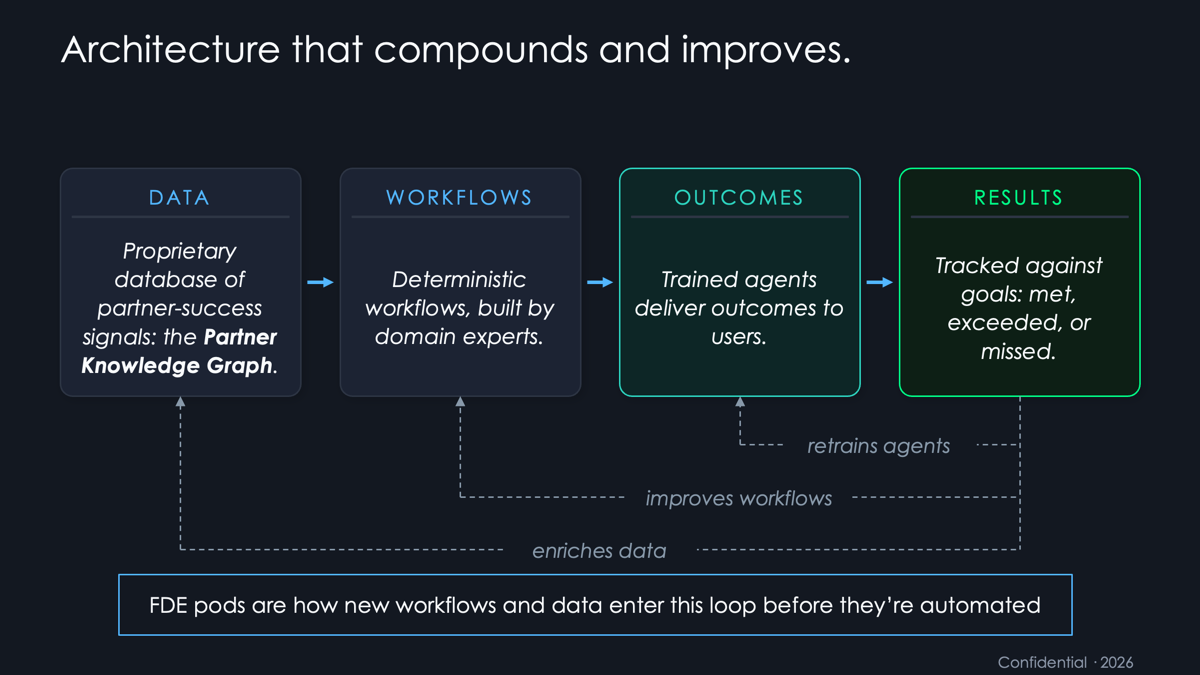 Data, workflows, outcomes, results, and the loop back. Domain Expert teams are how new workflows and data enter this loop before they are automated.
A consultancy's learning curve belongs to the consultancy. That is not a criticism, it is the business model: they get better at partnerships across all their clients, and you pay for access to the current version of that expertise. A Domain Expert team's learning curve belongs to you.
Put simply:
Consulting is headcount you rent. Domain Experts are headcount plus a platform you keep plus a system that gets better at your specific motion the longer it runs.
Priced on outcomes, not on hours
The pricing model follows directly from that.
Consulting is priced on time. Hourly, daily, or a fixed fee that is a time estimate with a margin on it. You pay for effort delivered, and the incentive structure rewards a longer engagement.
Paai Domain Expert pricing is half fixed and half variable, with the variable half tied to performance. On Discover, performance means how many partners moved into Growth. On Growth, performance is measured against the goal you defined, whether that is revenue, customers, or interactions. Four sizes, from a maximum of five partners up to enterprise, with integrations to email, PRMs, CRMs and co-selling tools included.
The discipline that forces is the useful part. Performance pricing requires the goal to be written down before work starts, attribution to be built in rather than reconstructed later, and both sides to agree on what counts. Most partner programs have never had that conversation, and having it is often the most valuable thing that happens in the first month.
Side by side
| Partnerships consultancy | Paai Domain Experts | |
|---|---|---|
| What you buy | Hours from experienced people | An outcome against a defined goal |
| How it is priced | Hourly, daily, or a time-based fixed fee | Half fixed, half tied to performance |
| Time to first output | Weeks, after scoping and a research phase | Minutes for discovery, days for outreach |
| How partners are found | Their network and their judgment | 5M+ partner success signals, scored and traceable |
| Hours it runs | Business hours, while engaged | Continuously |
| What you keep at the end | A deck and a set of recommendations | The platform, the workflows, the partner data, the plans |
| Where the learning goes | With the firm, to their next client | Into your workflows and your data |
| Gets better over time | Their expertise improves, across all clients | Your system improves, on your goals |
| Commitment to start | Scoped engagement | Discovery is free |
When a consultancy is the right call
Being honest about this matters, because the wrong answer here wastes real money.
Hire a consultancy when the problem is genuinely strategic and one-time. Which business unit should own partnerships. Whether to build a channel at all. How to restructure a program after an acquisition. Board-level positioning work. Those are judgment problems that benefit from an outside operator who has seen twenty companies solve them, and they do not recur, so there is nothing to keep.
Use Paai when the work is ongoing execution against a number. Finding the right partners, qualifying them, reaching the right person, recruiting, onboarding, growing the ones that produce, reporting on all of it. That work does not end, which means every hour you rent is an hour of learning you are giving away.
And if you are about to hire a partner leader, run the experiment first. Prove partners can produce for you before you build a team around the assumption that they will.
Related comparisons
Read next: Account Mapping at the Discovery Stage
Key takeaways
- A consultancy sells hours and keeps the learning. The engagement ends and the institutional knowledge leaves with it.
- Paai has no discovery calls, no 90-day campaigns, and no strategy deliverable. Discovery is free and returns results in minutes.
- The Domain Expert service combines domain experts, a workflow architect and customer success, plus two things consulting cannot include: the platform you keep, and a feedback loop that compounds on your goals.
- Pricing is half fixed and half performance, which forces the goal and the attribution to be defined up front.
- ClarifyAI reached live partner conversations in two weeks and a scheduled call in twenty-four hours, with no new headcount and no engagement to scope.
Frequently Asked Questions
No. Paai is a platform. Domain Experts are an optional service layer that runs the platform's workflows for you, and everything they build stays in your account when the engagement ends.
Domain Experts run your partner motions inside the Paai platform, supported by a workflow architect who tailors the workflows to your business model and customer success accountable to your goals. Unlike consultants, the workflows, data and plans they produce remain yours.
Consulting is priced on time. Paai Domain Expert engagements are half fixed fee and half variable, with the variable portion tied to performance against a defined goal.
No. Partner discovery is free and requires no call. You describe your goal or upload your target accounts and get scored partner candidates back.
It depends on whether you have proven the motion. Hiring first means spending two quarters finding out whether partners can produce for you. A Domain Expert engagement produces live partner conversations in weeks, which tells you what to hire for and whether to hire at all.
Written by
Delya Jansen
CEO
Leading Paai's mission to transform how B2B companies build and manage partnerships.
LinkedIn