Account Mapping at the Discovery Stage: Why Co-Selling Tools Cannot Help You Yet
Account mapping is the practice of comparing your customer and prospect list against a partner's to find shared accounts. Where you overlap, you have a co-selling motion: a warm introduction, a joint pursuit, or an expansion play.
It is one of the highest-yield activities in partnerships, which is why an entire software category exists to automate it.
That category has one structural limitation, and it is a big one. Every mainstream account mapping tool works by comparing two datasets that both sides have uploaded. That means both companies have to be customers of the same platform, both have to agree to share data, and both have to get that sharing approved internally.
Which is fine once you have partners. It is useless when you are trying to find them.
How account mapping works today
The established model is mutual data sharing. You connect your CRM to an account mapping platform. Your partner connects theirs. The platform compares the two lists and shows you the overlaps: shared customers, your customers who are their prospects, your prospects who are their customers.
The output is genuinely useful. It is also gated behind four conditions:
The partner has to be on the same platform.
If they are not, there is nothing to compare against. You can invite them, but you are now selling a software signup before you can even evaluate the partnership.
Both sides have to opt in.
Data sharing is a decision, not a default. It usually involves someone in IT and someone in legal.
You compare one partner at a time.
The model is bilateral by design. You pick a partner and see your overlap with that partner.
A relationship already has to exist.
Nobody shares their customer list with a company they have not met.
Read those four together and the gap becomes obvious. Traditional account mapping answers "how much do we overlap with this partner we already have?" It cannot answer the question that comes first.
The question that comes first
The question that comes first is: who is already selling into my target accounts?
You have a target account list. Maybe it is your Fortune 500 push, maybe it is a named-account plan for a new vertical, maybe it is the fifty logos your board wants next year. Somewhere out there is a set of companies with existing, delivered, referenceable work inside those accounts. Some of them are systems integrators with a standing statement of work. Some are technology vendors already in the stack. Some are boutique consultancies with a relationship at exactly the level you need.
Those are your best partner candidates, and you have no idea who they are.
A bilateral, opt-in account mapping tool cannot tell you, because you have not partnered with any of them yet. This is the chicken-and-egg problem at the center of the category: the tool that finds overlap requires a relationship, and the relationship is what you were trying to justify with the overlap.
So the discovery stage gets done the old way. Google. LinkedIn. Asking your account executives who else was in the room. A spreadsheet that ages badly.
One-to-many account mapping, on public data
companies
There is another way to do this, and it changes which question you can ask.
Instead of comparing your list to one partner's list, compare your list to the entire market at once. Public sources document a great deal of who works with whom: case studies, press releases, joint solution briefs, certifications, awards, conference sessions, partner directories, customer logos on websites. That evidence is scattered and unstructured, but it exists, and it can be collected and mapped to a taxonomy so it is queryable.
That is the model Paai uses for account mapping at the discovery stage. You upload your target accounts. Paai returns the partners already selling into them, with the evidence attached, scored and bucketed so you know where to start.
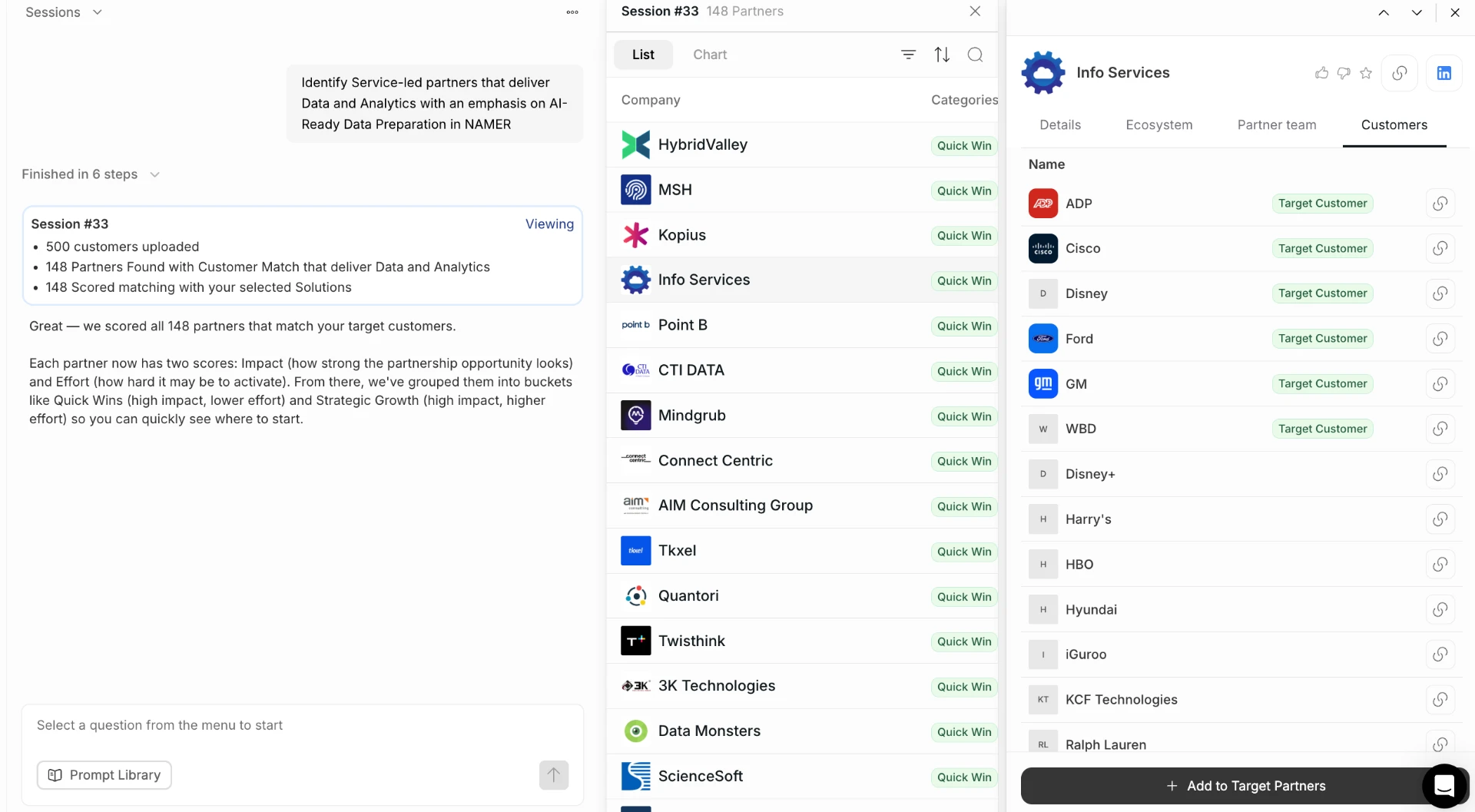 Five hundred customer accounts uploaded. One hundred forty-eight partners found that both match those accounts and deliver the solution area we specified, all scored and bucketed. The panel on the right opens one of them and shows the overlap directly: ADP, Cisco, Disney, Ford, GM and WBD are all flagged as target customers this partner is already inside.
Read that screenshot again, because the right-hand panel is the whole argument. That is account mapping output for a company we have never spoken to, that has never uploaded anything, that does not know Paai exists. No opt-in. No data-sharing agreement. No mutual platform. The overlap is publicly referenceable, which also means you can cite it in the first email.
Two consequences worth naming.
The direction is one-to-many. You are not asking "what is my overlap with this partner." You are asking "of every company in the market, which ones are already inside my accounts, and which of those are worth pursuing." One query, the full field.
Nothing has to be approved. This runs on public information, so there is no CRM connection, no data processing agreement, and no conversation with legal before you can look. Partner discovery on Paai is free, and the partner you are evaluating does not need to be a Paai user for it to work.
Do not stop at the list
A ranked list of partners who sell into your accounts is a good start, and a good start is where most tools stop. Then it is back to LinkedIn to guess at the right title, and back to a blank page to write the email.
Paai carries it through. For each target partner it identifies the stakeholders that matter, the partnerships lead, the sales leader, the practice owner, and drafts outreach built on the specific reason this pairing makes sense.
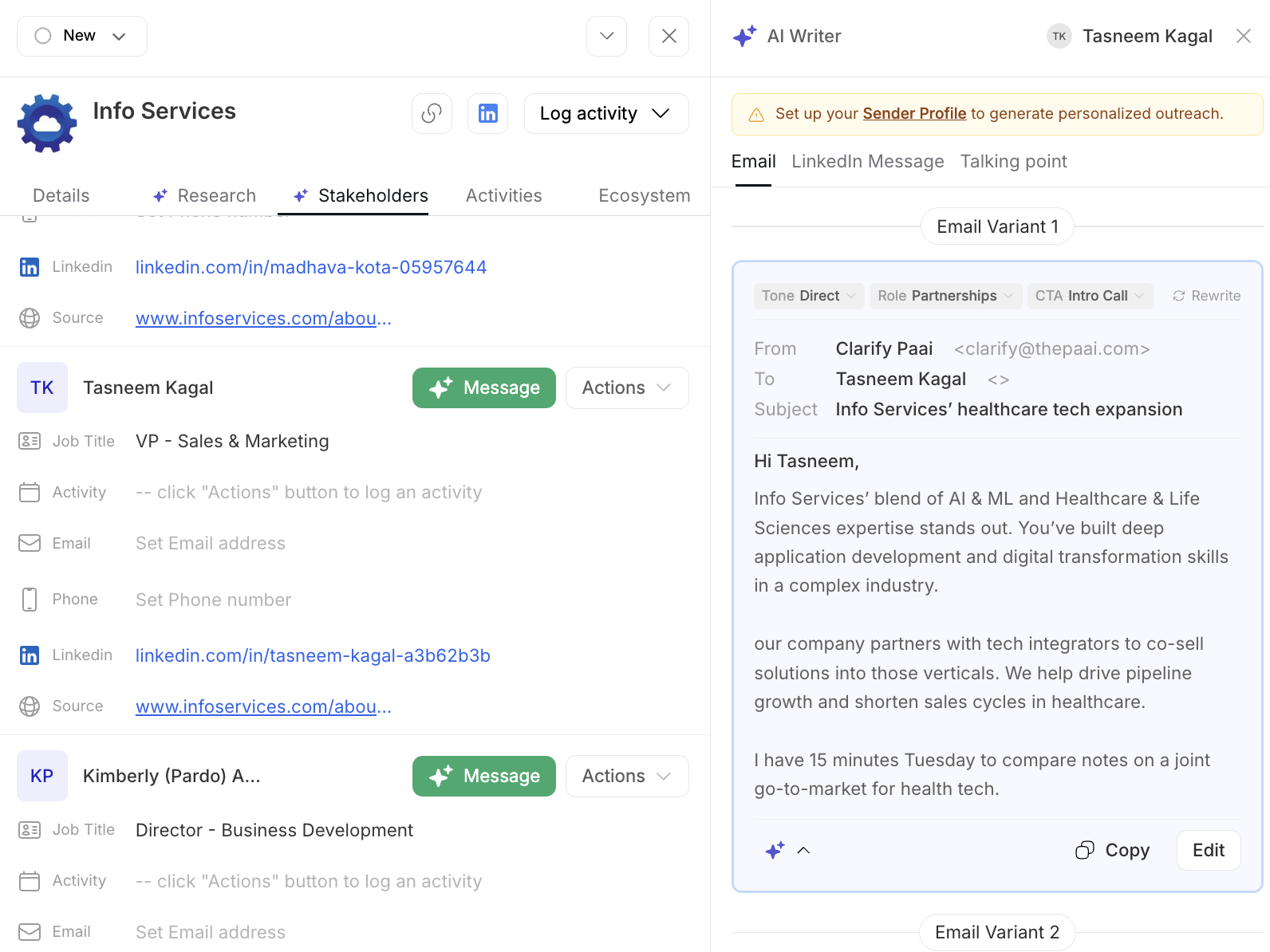 Named stakeholders with titles and sources on the left. On the right, a drafted email that leads with what this partner is actually strong in, states the co-sell motion in one line, and asks for fifteen minutes. Tone, role and call to action are adjustable, with multiple variants to choose from.
The message is not generic because it is not generated from a template. It is generated from the same profile that produced the score: what this company delivers, which verticals it sells into, which of your accounts it is already inside. That is why it reads like it was written by someone who did the homework.
The list is not the deliverable. The stakeholder and the message are what turn overlap into a conversation.
Where each approach fits
Both models are useful. They are useful at different stages, and confusing them wastes a quarter.
| Bilateral account mapping tools | Paai | |
|---|---|---|
| Core question | How much do we overlap with this partner? | Who is already selling into my target accounts? |
| Direction | One partner at a time | One to many, whole market at once |
| Requires the partner to opt in | Yes | No |
| Requires the partner to be a customer of the same tool | Yes | No |
| Data source | Both parties' CRM records | Publicly referenceable evidence across 500,000+ companies |
| Works before a relationship exists | No | Yes |
| Internal approval to get started | CRM connection, usually IT and legal | None |
| Output | Overlap counts and matched accounts | Scored partner candidates, the overlap, the stakeholder, and the drafted message |
| Best stage | Managing and expanding existing partnerships | Discovery, recruiting, and prioritization |
The honest summary: bilateral tools are strong at operating a partnership you already have, and Paai is strong at figuring out which partnerships to have. If you run a mature program with dozens of signed partners actively co-selling, the ongoing overlap tracking those tools provide is real value. Just do not expect them to help you build the list in the first place.
How to use Paai for account mapping at the discovery stage
The workflow is short.
- Upload your target accounts. Your named-account list, your top prospects, your Fortune 500 push. A CSV is fine.
- Say what kind of partner you need. Solution area, geography, and the segments you sell into. Plain language, not filters.
- Review the scored list. Candidates come back ranked on impact and effort and bucketed, so the shortlist is a decision rather than a reading assignment.
- Open the overlap. For any candidate, see which of your target accounts they are already inside, with the public evidence behind each one.
- Pick the stakeholder and send. Named contacts per partner, with drafted outreach you can adjust and send.
- Move the ones that qualify forward. Qualified candidates become target partners with a recruiting pipeline behind them.
Total elapsed time for step 1 through 4 is minutes, not the days per partner that manual research takes.
See how ClarifyAI used this workflow to reach enterprise consulting partners in weeks.
Related comparisons
Read next: Paai vs. a Partnerships Consultancy
Key takeaways
- Account mapping means comparing your accounts against a partner's to find shared customers and prospects worth co-selling into.
- Mainstream account mapping tools are bilateral and opt-in, so they require the partner to already exist, to agree to share data, and to be on the same platform.
- That makes them unusable at the discovery stage, which is exactly when knowing who sells into your accounts is most valuable.
- One-to-many account mapping on public data inverts the question: instead of one partner's overlap, you see every company already inside your target accounts.
- The list is not the deliverable. The stakeholder and the message are what turn overlap into a conversation.
Frequently Asked Questions
Account mapping is the practice of comparing your customer and prospect accounts against a partner's to find shared accounts. Overlaps point to co-selling opportunities: warm introductions into accounts the partner already serves, joint pursuits, and expansion plays inside shared customers.
With traditional account mapping tools, yes. They compare two uploaded datasets, so both sides must be on the same platform and both must approve the data sharing. Account mapping based on publicly referenceable evidence does not require the other side to participate, which is what makes it usable before a partnership exists.
Yes, if the mapping runs on public information rather than mutual CRM sharing. You upload your target accounts and get back the companies already selling into them, along with the public evidence. This is the discovery-stage version of account mapping, and it is how you decide who to recruit.
No. Account mapping is the analysis that identifies shared accounts. Co-selling is the motion you run once you have found them, which involves aligned sellers, an agreed play, and attribution. Mapping tells you where the opportunity is. Co-selling is the work of capturing it.
Partner discovery, including uploading your target accounts and seeing which partners already sell into them, is free. There is no CRM integration required and the partners you are evaluating do not need to be Paai users.
Written by
Delya Jansen
CEO
Leading Paai's mission to transform how B2B companies build and manage partnerships.
LinkedIn