Why generative AI can't solve partner discovery
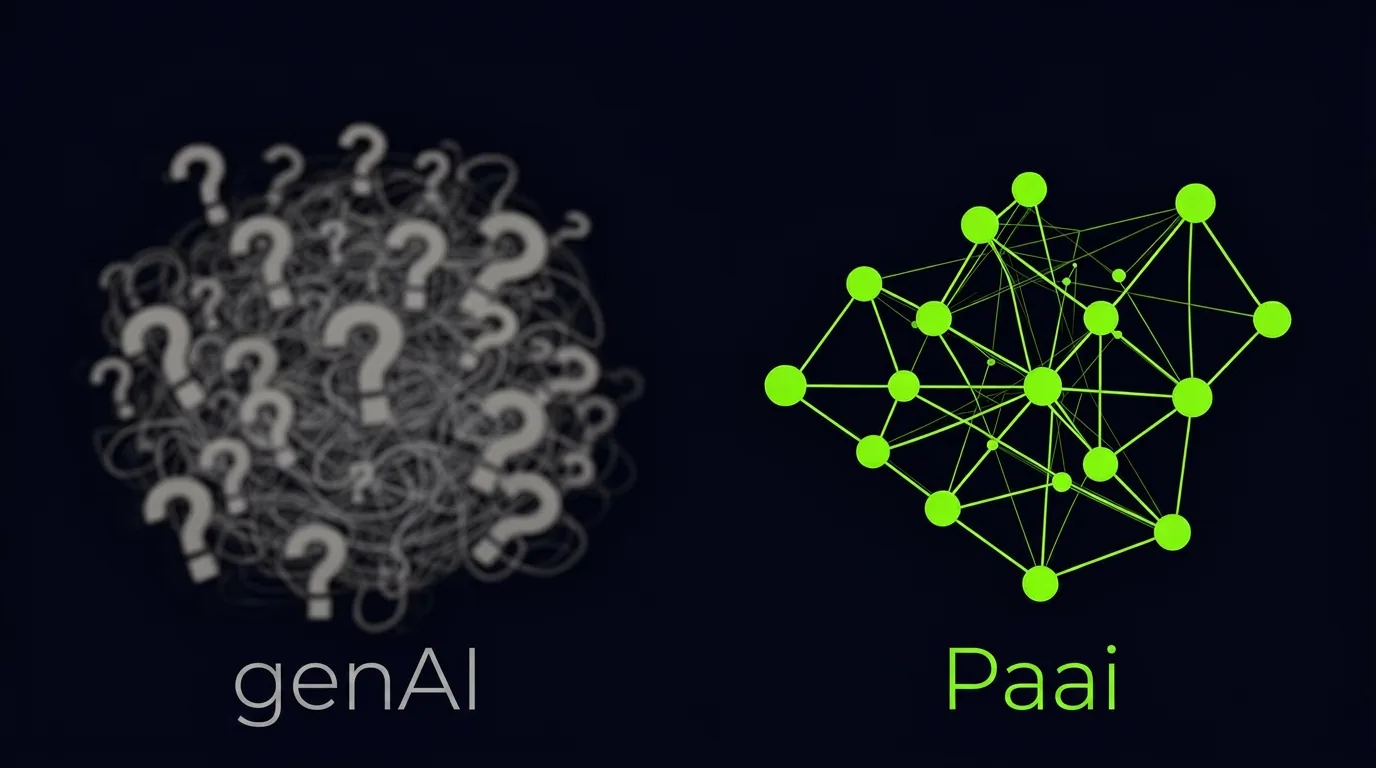
Key Takeaways
- 1Leading LLMs hallucinate above 10% on next-generation benchmarks.
- 2Named companies come from training memory, not a live partner database.
- 3Outputs are probabilistic, under 1-in-100 chance of identical runs.
- 4Deterministic scoring requires deterministic, structured data underneath it.
- 5Paai scores 500K+ companies in a verified Partner Signals Data.
Finding the right partners is a structured data problem. But most teams approach it like a search query, typing prompts into generative AI tools and trusting what comes back. The research shows why that doesn't work.
This post looks at what the empirical literature tells us about where large language models break down in partner discovery. It also covers why we built a deterministic scoring engine at Paai, and the data infrastructure we had to build alongside it to make that scoring valid.
Three reasons the research says this fails
10%+ hallucination rate
- On Vectara's grounded summarisation benchmark, GPT-4o hallucinates at 1.5%, Gemini at 0.7%, and Claude Sonnet at 4.4% under ideal conditions.
- On the harder next-generation benchmark, every major thinking model including Claude Sonnet 4.5, GPT-5, Grok-4, and Deepseek-R1 crosses 10%.
- An Ahrefs study of 16 million AI-cited URLs found AI assistants send users to dead pages 2.87x more than Google Search. ChatGPT is the biggest offender at 2.38% of all cited URLs returning a 404.
- Fewer than half of LLM-generated references correspond to real, verifiable sources.
For partner discovery, a chatbot can confidently name a company that does not fit your goals, does not operate in your segment, or does not exist as described.
How Paai handles this: Every company in results is verified in the Partner Signals Data before any scoring runs. Hallucination risk is zero.
Training memory, not a real database
- Seer Interactive analysed 362,188 LLM responses in their 2026 "LLM Ghost Citations" study.
- The model generates its answer first, deciding which companies to name from parametric memory. It then retrieves sources to support those choices after the fact.
- The citations are the bibliography, not the brainstorm.
- ChatGPT does not browse by default. Perplexity retrieves live on every query. Copilot and Gemini draw on Bing and Google indexes. But the choice of which companies to name is driven by training-data brand recognition, not a real-time database search.
For partner discovery, you get the loudest brands, not the best strategic fit. High-fit, lower-profile partners stay invisible.
How Paai handles this: Scoring runs against 500K+ companies in the Partner Signals Data, evaluated on solution fit, target markets, and competitive risk. Not training data recall.
Probabilistic guesses, not ranked results
- A SparkToro/Gumshoe.ai study had 600 volunteers run 12 identical prompts across ChatGPT, Claude, and Google AI a combined 2,961 times in November and December 2025.
- There is less than a 1 in 100 chance that any two runs return the same list of brands in the same order.
- Rand Fishkin concluded that treating these tools as a source of ranking consistency is "provably nonsensical".
- The only stable signal is aggregate mention frequency. In the headphones category, Bose, Sony, Sennheiser, and Apple appeared in 55 to 77% of responses regardless of how dramatically the prompt changed.
That's a brand visibility metric, not a partner fit score. There is no ranking. There is no scoring. Just noise that sounds confident.
How Paai handles this: Deterministic scoring means same inputs always return the same output. Rankings are traceable to defined signals, not sampling.
Why we invested in deterministic scoring
When we looked at how partner teams were using AI tools to build their ecosystem strategies, a clear pattern came up. The outputs felt useful but weren't reproducible, weren't rankable, and couldn't be traced back to any verified source. Teams were making real decisions, prioritising outreach, allocating headcount, choosing co-sell motions, based on probabilistic text.
The core issue is that language models are trained to produce fluent, contextually appropriate text. When you ask one to recommend partners, it does exactly that. It produces a plausible-sounding list. But plausible isn't the same as accurate, and fluent isn't the same as ranked.
Partner discovery needs a system where the same inputs always produce the same outputs. Where every score is traceable to a defined set of signals. Where the logic can be interrogated and improved over time. That's what deterministic means, and it's what we built.
How Paai's scoring works
Every company in the database is evaluated across two independent dimensions, Impact and Effort, using a fixed scoring function. Same inputs, same scores, every time.
Solution group match (hard gate) → solutions overlap → target market group alignment → sub-sector alignment → focus multiplier favouring specialists.
Solution overlap delta + partnership program maturity + company size → amplified by a competition multiplier based on existing relationships with your rivals.
Each partner lands in one of four quadrants:
Strong fit, easy to activate. First priority for pipeline.
Strong fit, complex to engage. Worth the investment.
Lower fit, easy to work with. Good for distribution volume.
Lower current fit, high complexity. Worth monitoring.
Deterministic scoring needs deterministic data
Building the scoring engine was only half the problem. The harder question was: what does it score against?
Pointing a structured scoring model back at generative AI for data collection would have reproduced every problem we were trying to solve. If the underlying data is probabilistic, sourced from language model outputs or unverified web scrapes, the scores that come out carry the same instability. Even if the scoring function itself is fixed.
So we built the Partner Signals Data from scratch. The principle is simple: deterministic scoring is only as good as the structured, verified data behind it. You can't have one without the other.
Partner Signals Data
- Pre-populated with proprietary partner intelligence at launch, not sourced from LLM outputs.
- Every field used in scoring, solutions, target markets, partnership maturity, competitive relationships. Is structured, taxonomy-mapped, and continuously enriched.
- Signals accumulate across every discovery, engagement, and execution motion.
- Partners not yet in the database go through a five-stage enrichment pipeline: motion classification, solution assignment, firmographic enrichment, AI enrichment, then persist and score.
See it working for yourself
Sign up to see how deterministic scoring and the Partner Signals Data surface partners that generative AI cannot find.
Sign upFrequently Asked Questions
They're built to generate fluent language, not to query a structured partner database. Outputs vary run-to-run, named companies come from training-data prominence rather than fit, and there is no scoring or ranking logic underneath.
Every company is evaluated with a fixed scoring function across two dimensions, Impact and Effort, using structured fields. The same inputs always produce the same scores. No probabilistic sampling.
The Partner Signals Data: 500K+ companies and 5M+ partner signals, pre-populated with proprietary intelligence, taxonomy-mapped, and continuously enriched.
Written by
Paai Research
Research Team
Original research from the Paai team on partnerships, AI, and ecosystem strategy.
LinkedIn