What Is Partner Goal Attainment? (And Why It Replaces Partner Activity Metrics)
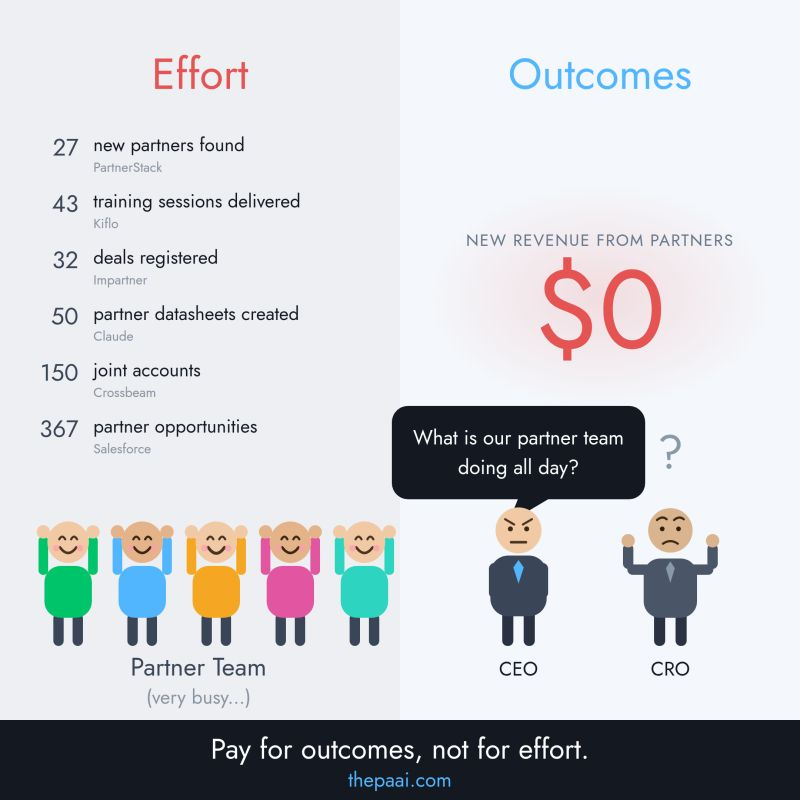
Every QBR, the same thing happens. The partner team walks in with a deck full of numbers. The CEO and CRO walk out asking the same question they asked last quarter: where's the revenue?
Here's what a typical slide looks like:
- 27 new partners found in PartnerStack
- 43 training sessions delivered in Kiflo
- 32 deals registered in Impartner
- 50 partner datasheets created in Claude
- 150 joint accounts in Crossbeam
- 367 partner opportunities in Salesforce
Six tools. Six numbers. Zero answers to the only three questions leadership actually has: Additional revenue from partners? New customers from partners? Bigger deals? Silence.
This is not a partner team problem. It is a training problem. Most partner teams were built and coached to track effort, not outcomes. So they get very good at proving they were busy, and nobody taught them how to prove they moved the business. That gap has a name: partner goal attainment. And no PRM or co-selling tool is going to close it, because none of them were built to.
Effort
- 27new partners found (PartnerStack)
- 43training sessions delivered (Kiflo)
- 32deals registered (Impartner)
- 50partner datasheets created (Claude)
- 150joint accounts (Crossbeam)
- 367partner opportunities (Salesforce)
Partner Team (very busy...)
Outcomes
New revenue from partners
“What is our partner team doing all day?”
CEO / CRO
Pay for outcomes, not for effort.
thepaai.com
What Is Partner Goal Attainment?
Partner goal attainment is measuring whether a partner program hit the company's actual goals, revenue, pipeline, market expansion, instead of measuring whether partners were busy.
Obvious once you say it out loud. Almost nobody builds their program this way. Most run on top of a PRM, which is a very expensive filing cabinet: it logs deal registrations, portal visits, MDF claims. It will tell you a partner logged in six times last month. It will not tell you if that partner is worth another dollar of investment.
Activity tracking asks "did the partner do something?" Attainment asks "did the program hit the number the CEO cares about?" If your partner team is under ten people, this is the difference between getting more headcount next year and getting quietly folded into sales.
Partner Activity vs. Partner Attainment: A Side-by-Side Comparison
| Partner Activity | Partner Attainment | |
|---|---|---|
| What it measures | Logins, registrations, certifications, MDF claims | Revenue, pipeline, market expansion against company goals |
| What it optimizes for | Looking busy in the portal | Moving the business |
| What it misses | Whether any of it made money | Nothing, if the goal was set correctly |
| Who it impresses | Nobody, if we're honest | CFOs and CROs |
Two partners, same quarter. Partner A logs in weekly, registers a dozen deals, downloads every asset you hand them. Textbook activity. Zero of those deals close. Attainment: zero. Partner B barely opens the portal, registers nothing, and quietly drives 30% of new ARR through warm intros and joint selling nobody logged anywhere. Attainment: real.
A program built on activity gives Partner A the gold star and never notices Partner B. A program built on attainment does the opposite, and that is the entire point.
Why Underperforming Partner Programs Are Usually a Measurement Problem
Most "underperforming" partner programs are not actually underperforming. They are just being measured wrong. Three gaps show up constantly:
Attribution. Revenue a partner influenced never gets traced back to them, especially when a direct rep closes the deal and the partner's fingerprints are all over the middle of the deal cycle.
Goal alignment. Partner KPIs get set in a vacuum. The team hits "20 new partners signed" while the company needed revenue in a new vertical, and both sides walk away thinking the other one dropped the ball.
Signal quality. The data that could answer this, CRM notes, half-remembered calls, a Slack message about who introduced whom, is scattered and unstructured. This is the exact gap Partner Signals Data™ was built for: a standardized dataset across 500K+ companies and 5M+ signals, built to separate what actually predicts attainment from what just looks like activity.
How to Set Partner Goals That Are Actually Attainable
Start at the company's number, not the partner team's to-do list. Take the company's actual revenue target for the period, figure out how much of it partners can realistically influence, and make that the goal. Not "sign 20 partners." Not "run 5 webinars." The number.
Then stop applying one benchmark to six different partner types. Channel, technology, ISV, cloud, OEM, hardware, none of them move revenue the same way or on the same timeline. Judge a hardware OEM by a channel reseller's benchmark and you'll declare five out of six partner types a failure by Tuesday.
For a lean team, "aligned to company goals" means every workflow you run, discovery, outreach, enablement, reporting, ties directly to the two or three things the company actually cares about this quarter. Not a vague sense that partnerships are generally a good idea.
Proving Partnership Value to Leadership
CFOs and CROs will not read a slide about portal engagement. Three numbers get their attention:
Revenue directly attributable to partners. Not touched, not influenced, attributable: deals that would not have closed, or would not have closed this big, without the partner.
Pipeline contribution against the company's growth target. What share of this quarter's new pipeline is partner-sourced or partner-influenced.
Cost per attained outcome versus cost per activity. What it costs to produce a dollar of attributable revenue, versus what it costs to produce a login.
Fast-growing CRM company ClarifyAI made exactly this switch: instead of reporting portal engagement, they reported which partners were producing revenue and which conversations turned into qualified pipeline in weeks, not quarters. That's what got the program more budget instead of less. Read the full ClarifyAI story.
The Agentic Partner OS Approach to Goal Attainment
This is why we built Paai. Not another dashboard to check or another tool to manage. An agentic workflow that understands your goals, activates the right agents to hit them, and de-risks your partnerships in real time, instead of asking you to reconcile six spreadsheets at QBR time and hope the story adds up.
It runs on Partner Signals Data™, our proprietary dataset of 500K+ companies and 5M+ signals, built specifically to separate real attainment signal from activity noise. And if you don't have a dedicated partner hire yet, AI Native Partner Services runs the same workflows for you until the motion is proven and ready to bring in-house.
Nobody actually wanted the login count. They wanted to know if the partner program moved the business. Partner goal attainment is what happens when you measure that directly, instead of hoping six tools' worth of activity adds up to an answer.
Written by
Delya Jansen
CEO
Leading Paai's mission to transform how B2B companies build and manage partnerships.
LinkedIn