From Knowledge Graph to Launch: 12 Months Inside Paai's Build
Key Takeaways
- 1Paai's hypothesis: consistently selecting the right partners can improve partnership success rates by up to 90 percent.
- 2The Partner Signals Data™ was built before users arrived, so goals and ICP overlay an ecosystem the platform already understands.
- 3Deterministic scoring models encode how top partner managers evaluate impact and effort, keeping AI anchored and explainable.
- 4Instead of one copilot, Paai built specialized agents. Discovery, fit, stakeholder, engagement, and briefing. Each owning a slice of the workflow.
- 5Early pilots show close to 100% outreach response rates and around 90% of partners on track to meet first-quarter metrics.
As Paai gets ready to launch its first product, here is how they actually got here, from the seat of an advisor watching a twelve month build unfold.
The Paai team started with a simple but strong theory: if a company consistently selects the right partners, it can improve partnership success rates by up to 90 percent.
Most failures, they believed, were not because partnerships were a bad idea, but because teams were flying blind on the front end. Guessing who to bet on, why, and how to engage. Paai exists to change that. Here is how they got there over twelve months.
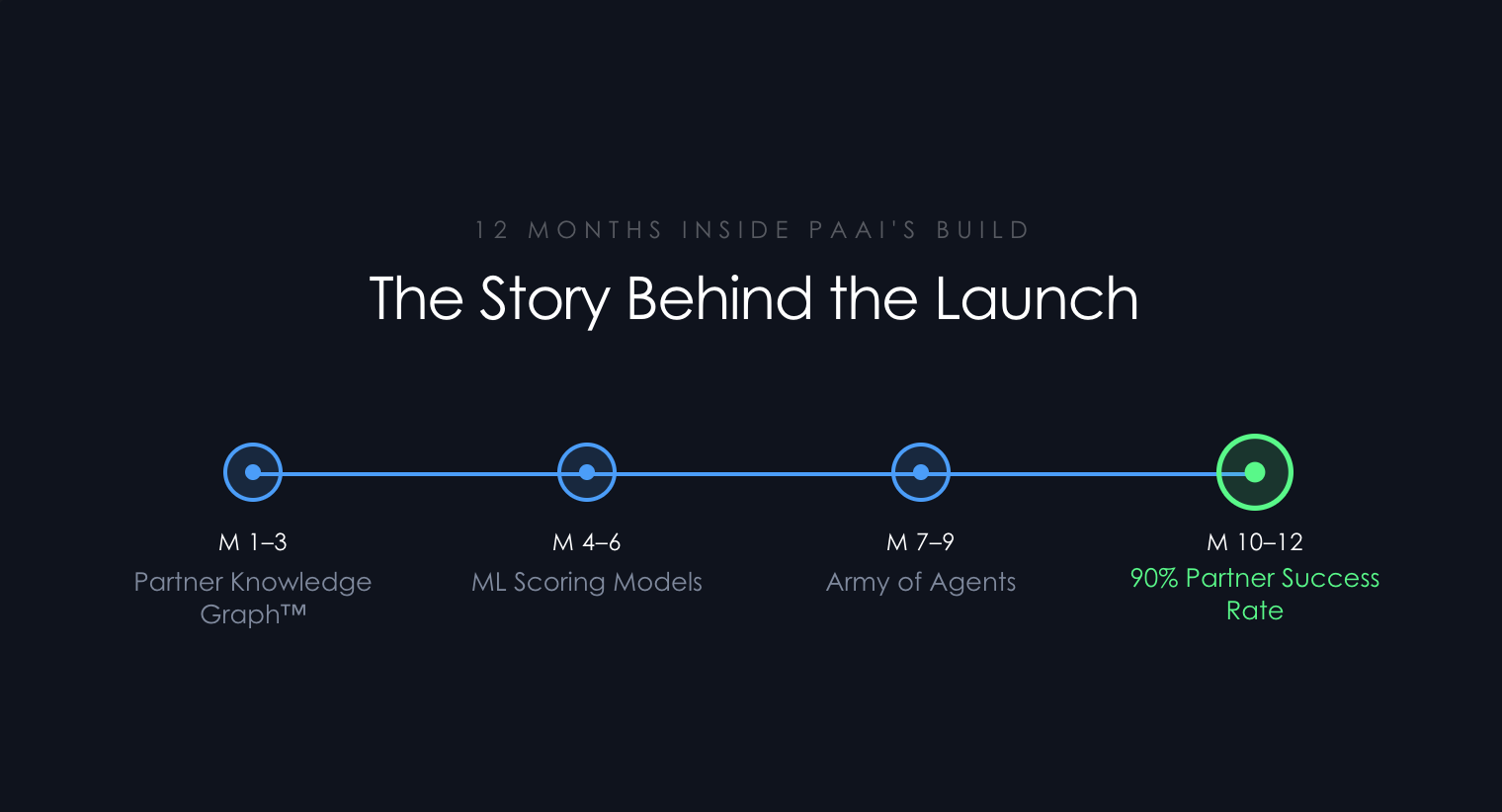
Month 1 to 3: Do not start with a blank page
The first thing that stood out was what they did not do.
Most AI products start empty and wait for someone to clean a CRM and wire up integrations before anything works. Paai took the opposite approach. From day one they committed to a Partner Signals Data™, a living map of companies, products, integrations, markets, people, and partnership signals.
By the time early users arrived, Paai already "knew":
- Who sells to whom
- Who integrates with whom
- Who partners with whom
- Where partnerships have clearly moved revenue
Goals and ICP are not dropped into a void. They are overlaid on a graph that already understands the ecosystem. That is the foundation everything else sits on, and it is what makes Paai more than a generic model with a long context window.
Month 4 to 6: Encode how great partner managers think
The next phase was all about encoding judgment.
Instead of asking great partner managers how they would design a neural network, the team asked how they decide where to spend time:
- This partner has high overlap with our ICP and product surface and low friction to activate.
- That partner looks amazing on paper but is over-extended in our category and does not have clear ownership.
- This is a stretch bet but if it hits it changes our position in this vertical.
Those instincts were turned into something machines can use.
They captured how people score partners on two axes: impact, which is what this could drive for the business, and effort, which is how hard it will be to activate.
They built deterministic scoring models, explicit rules and weights that say: given these signals, this partner moves up or down the list.
On top of that, they trained specialized models for fit, stakeholder relevance, next best actions, and content generation for briefs and outreach. All grounded in the graph.
The result is an AI that does not just produce fluent text. It behaves like a well-trained partner manager with a very structured memory. Deterministic modules keep it anchored and explainable. Learned models give it flexibility and scale.
Month 7 to 9: Agents that own real work
Once the Partner Signals Data™ and judgment layer were real, the question became how to turn this into execution, not just insight.
This is where the agentic part shows up.
Instead of one big generic copilot, Paai became a small virtual team of agents, each owning a slice of the workflow. From the outside, the pattern looks like this.
A user states a goal in plain language, for example:
- "Grow partner-sourced pipeline in fintech this quarter."
- "Get ten serious co-sell conversations going with a key ecosystem."
- "Revive a stalled alliance with a concrete ninety-day plan."
Under the hood, Paai turns that into a workflow that moves through discovery, research, engagement, briefing and planning, and follow-up. Different agents own different parts.
- A discovery agent queries the Partner Signals Data™ with the goal and returns a ranked set of candidate partners, answering "who should we partner with?"
- A fit and rationale agent computes impact and effort scores and generates a human-readable "why this partner" explanation with signals and citations.
- A stakeholder mapping agent identifies relevant roles and people in the target organization and annotates them with likely interests and motion alignment.
- An engagement agent proposes outreach angles and sequences based on the fit narrative and drafts tailored copy for email, LinkedIn, and intro requests.
- A briefing and planning agent assembles everything into a partnership brief with goals, KPIs, risks, and recommended next steps for internal stakeholders.
Humans stay in the loop where they add the most value. They approve or reject partner candidates, adjust priorities and goals, tune the tone of messaging, and have the actual conversations that build relationships.
Equally important is what is not required. Users do not start from empty fields and blank documents. They do not have to manually orchestrate a pile of tools. They do not have to remember to return to the system just to keep a status current. The agents push the work forward and surface decisions at the right times instead of sitting passively and waiting for input.
Month 10 to 12: What pilot customers are seeing
The original theory was that if selection is fixed on the front end, partner success can improve by up to 90 percent. The pilots are starting to bear that out.
Early customers are reporting that close to one hundred percent of the partners they find through Paai are responding to outreach. Even more important, around ninety percent of those partners are on track to meet or exceed their first-quarter partnership metrics, whether that is qualified meetings, joint opportunities, or early revenue.
In practical terms, that means:
- The upfront partner list is no longer a random mix of guesses and favors.
- The "why this partner" story is clear and defensible, both externally and internally.
- Plays are starting with the right partners, which dramatically increases the odds that time spent on enablement, co-marketing, and co-sell will pay off.
From an advisor seat, that is the arc that matters as Paai approaches launch. This is not "AI for partnerships" as a slogan. It is a team that started with a specific hypothesis about what actually drives partner success, spent a year encoding the craft of great partner managers into graphs, scoring, and agentic workflows, and is now seeing early customers confirm the bet in their numbers.
The technology is impressive. The more important part is that it is finally making the one part of partnerships no team can afford to get wrong, partner selection and early execution, feel like a repeatable, scalable engine instead of a high-stakes guessing game.
Frequently Asked Questions
It's a living map of companies, products, integrations, markets, people, and partnership signals that Paai built before users ever arrived. So your goals and ICP are overlaid on an ecosystem the platform already understands.
Paai uses deterministic scoring for impact and effort, explicit rules and weights built by studying how top partner managers decide where to spend time. Specialized models layer on top for fit, stakeholder relevance, and next-best action.
Instead of one copilot, Paai built a team of agents. Discovery, fit & rationale, stakeholder mapping, engagement, and briefing. That run a play from discovery through follow-up, with humans staying in the loop where they add the most value.
Early pilots report close to 100% outreach response rates and around 90% of partners on track to meet or exceed first-quarter partnership metrics, whether that's qualified meetings, joint opportunities, or early revenue.
Written by
Michael Letschin
Advisor, Paai
Michael Letschin is an Advisor to Paai, bringing deep experience in partnerships and channel strategy to help shape the platform's go-to-market and product direction.
LinkedIn